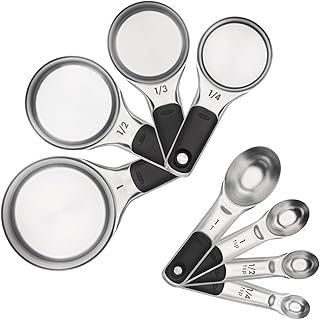
Measuring cups and spoons are fundamental baking and cooking tools. Accurate measurement is especially critical in baking, where small variations in flour, leavening, or liquid can significantly affect results.
Dry vs. Liquid Measuring Cups
Dry and liquid measuring cups are designed differently and are not interchangeable for accuracy.
Dry measuring cups have flat tops and are filled to the brim then leveled off. They come in 1/4, 1/3, 1/2, and 1 cup sizes. They are designed to be dipped into flour, sugar, or other dry ingredients and leveled with a straight edge.
Liquid measuring cups have a spout, a handle, and markings on the side. They are designed to be set on a flat surface and read at eye level. Common sizes are 1, 2, and 4 cups.
Dry Measuring Cup Materials
Stainless Steel
Stainless steel dry measuring cups are durable, rust-resistant, and easy to clean. They maintain their shape over time — plastic cups can warp, affecting rim straightness and accuracy.
Plastic
BPA-free plastic cups are inexpensive and lightweight. For baking, plastic cups can crack or warp over time. Avoid cheap plastic sets for serious baking.
Liquid Measuring Cup Materials
Tempered Glass
Pyrex tempered glass measuring cups are the standard. They are microwave safe, dishwasher safe, heat resistant, and the markings do not fade. These last indefinitely with normal use.
Plastic (Angled)
OXO and similar brands make excellent angled plastic liquid measuring cups with interior markings visible from above without bending down to eye level. This is a genuinely useful innovation — you fill to the line while looking down.
Measuring Spoons
Standard measuring spoon sets include 1 tablespoon, 1 teaspoon, 1/2 teaspoon, and 1/4 teaspoon. Better sets also include 1/8 teaspoon. Oval-shaped spoon heads fit more easily into spice jars and narrow containers. Long handles give better control.
Stainless steel spoons are the most durable and accurate — they maintain their shape. Plastic spoons can warp or crack in dishwashers.
Accuracy in Measurement
The correct method for flour: spoon flour into the cup, then level off with a straight edge. Scooping directly from the bag compresses the flour and results in 10-20% more flour than intended. A kitchen scale eliminates this variability entirely.
What to Look For
For baking, a stainless steel dry measuring cup set with straight, flat rims and a tempered glass liquid measuring cup are the best combination. For measuring spoons, a stainless set with oval heads and long handles covers all practical needs.
Summary
Measuring cups and spoons are simple tools where material quality and design accuracy directly affect cooking and baking results. Stainless steel for dry cups, tempered glass or angled plastic for liquid, and stainless for spoons gives you a reliable set that performs accurately for years.
You can check more details and current options on Amazon here.